Is it easy to become a saint?
I recently had a visit to the dentist and later the thought came to me that becoming a saint is like going to the dentist.
1. First you have to want to go! There are other things you may want to do. You may have other priorities. You may have some fear. It is easy to put it off. There may be a cost involved of minimally time and maybe parting with some of our wealth.
2. You have to show up. I googled “catholic what does it mean to show up” and here is what Artificial Intelligence responded. In a Catholic context, “showing up” primarily refers to actively engaging in one’s faith and following Christ’s teachings. This can manifest in various ways, including regular attendance at Mass, prayer, participation in sacraments, service to others, and living a life of charity and virtue.
3. Minimally you have to trust the dentist to some extent otherwise you may not get past step two. The dentist has your best interest at heart and knows what they are doing. I may not understand all he is doing. However sometimes it helps if you research the process and thus develop an understanding of what is going on. This could be asking questions of the dentist or their helpers. Reading material about the subject. Reading accounts of others that have gone through the process.
4. You have to cooperate with the dentist and their helpers. With the dentist it is to do what he/she wants you to do. Simple things like open, close, bite down. Again making use of AI “In Catholic theology, cooperating with God, or “cooperating with grace,” means actively working alongside God in his plan for salvation and sanctification.” To me it sounds like doing the will of God in small or big things. This entails obedience to the Ten Commandments and the teaching of the Catholic Church. Other than that it is living in the present, realizing God has willed you to be where you are and to think of God often. In the book of Micah the Lord says “You have been told, O mortal, what is good, and what the LORD requires of you: Only to do justice and to love goodness, and to walk humbly with your God.”
5. There may be some fear or suffering involved. But nothing that thru the concern and care of the dentist that you can’t handle. It will work out for your own good.
6. The dentist does all the actual work. They clean your decay and fill your cavities. I have never heard of a dentist sending someone away because they were is such bad shape. They will work with anyone.
In a sense today getting better dental health is easy since we don’t actually do the work. In the end any suffering or discomfort will pass and have been worth it. Maybe becoming a saint is similar. Similar to the dentist healing our teeth, except God is healing our souls.
This is just another way to look at sainthood. In reality becoming a saint may be both easy and hard. It is hard in the sense that as Jesus said we must take up our cross and the road is narrow and not the easy broad path. We have to in a sense die to our selfishness and our ego. However Jesus also said
“Come to me, all you who labor and are burdened, and I will give you rest.
Take my yoke upon you and learn from me, for I am meek and humble of heart; and you will find rest for yourselves.
For my yoke is easy, and my burden light.”
A yoke is designed for two; Jesus “shoulders the yoke” with us. We are not carrying the cross alone; He provides the grace and the strength. I would imagine it is a tool of the devil to make one think that becoming a saint is just too hard and to abandon that idea. Sometimes it is good to look at it from the easy side. That in a sense that all can achieve it. However if you feel it is easy and you are on your way then maybe you are not trying hard enough. Always remember that the Lord and Creator of the universe is on your side in the path to sainthood. Ask and you shall reecive.
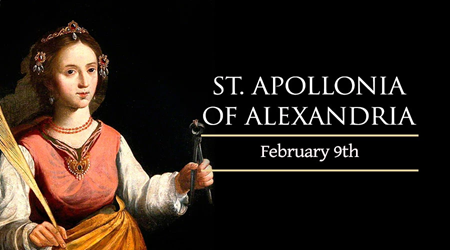
February 9th is the feast day of Saint Appollonia.
St. Apollonia was a holy virgin who suffered martyrdom in Alexandria during a local uprising against the Christians in the early 3rd century. During festivities commemorating the founding of the Roman Empire, a mob began attacking Christians. The great Dionysius, then Bishop of Alexandria (247-265), related the sufferings of Apollonia:
Men seized her and, by repeated blows, broke all of her teeth. Then they erected a pile of sticks outside the city and threatened to burn her alive if she refused to repeat impious words after them (either a blasphemy against Christ, or an invocation of the heathen gods). When she was given a little freedom, at her own request, she sprang quickly into the fire and was burned to death.
Apollonia belongs to a class of early Christian martyrs who when confronted with the choice between renouncing their faith or suffering death, voluntarily embraced the latter. She is popularly invoked for toothaches because of the torments she had to endure. She is represented in art with pincers holding a tooth.