The sport of football has developed a vast array of analytics and metrics that are used by fans, teams and players to measure, analyze, quantify and improve the sport. Analysis revealed that 78% of NFL teams used predictive analytics to inform draft choices, showing widespread adoption in talent selection processes. A 2023 report found 65% of U.S. sports organizations invested in wearable technology for real-time biometric and performance data collection. Teams applying AI-based play prediction improved third-down conversion rates by 5.2% in the 2023 season. This mathematical number crunching is a search for truth through numbers and math. The universe is structured and ordered following a set of principles that can be understood though science and mathematics. The argument can be made that this points to a Grand Designer or God. In this post I will look at finding God in mathematics.
The Golden Ratio
The golden ratio is one of the most amazing patterns in the world that point towards a Supreme Being. Take a line segment and pick a point on the line to divide it into two segments. If you pick that point so that the ratio of the whole line to the longer part is equal to the ratio of the longer part to the shorter part, then your point divides the line in the golden section. The ratio is called the golden ratio and can be computed to be about 1.61803 to 1. Euclid documented this ratio in his Elements using a straight edge and a collapsing compass around 300 BC. However he called it the “extreme and mean ratio”.
A related mathematical concept, The Fibonacci numbers, were first described in Indian mathematics as early as 200 BC in work by Pingala on enumerating possible patterns of Sanskrit poetry. It was later documented by Leonardo of Pisa, also known as Fibonacci, who introduced the sequence to Western European mathematics in 1202. It is defined as a infinite sequence where each number is the sum of the two preceding ones, starting with 0 and 1. So the sequence would be 0, 1, 1, 2, 3, 5, 8, 13, 21, 34, …. . It was not until 1608 when astronomer Johannes Kepler first noted that the ratio of consecutive Fibonacci numbers converges to the golden ratio.

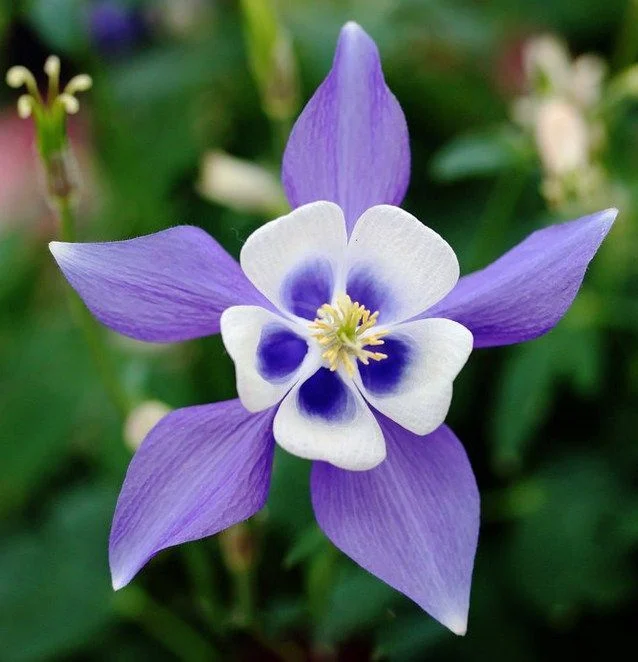
Nature demonstrates the Fibonacci sequence and golden ratio to optimize space and maximize exposure to resources like sunlight and rain. The number of petals on many flowers is a Fibonacci number.
Lilies and irises have 3 petals.
Buttercups and wild roses have 5 petals.
Delphiniums have 8 petals.
Daisies can have 21, 34, 55, or even 89 petals.
The seeds in the center of a sunflower or the scales on a pine cone form two sets of interlocking spirals, with the count for each direction typically being consecutive Fibonacci numbers (e.g., 34 clockwise and 55 counter-clockwise). This arrangement allows for optimal packing of the seeds. We also see the golden ratio in tree branches as they start with one trunk, which splits into 2, then one of the new branches splits into 2, and this pattern continues.

The shape of a nautilus shell, the curl of a seahorse’s tail, and the spiral patterns of hurricanes and spiral galaxies all approximate the golden spiral, a logarithmic spiral derived from the golden ratio. See the figure on left.
Proportions within the human body, such as the ratio of the forearm to the hand, the length of finger segments, and the spacing of facial features, often approximate the golden ratio. A cycle of the DNA molecule measures 34 angstroms long by 21 angstroms wide, which are consecutive Fibonacci numbers.

For centuries, artists and architects have used the golden ratio to create works that are considered visually pleasing and harmonious to the human eye. Renaissance artists like Leonardo da Vinci and Salvador Dalí used the golden ratio for composition and proportion in famous works such as the Mona Lisa and The Sacrament of the Last Supper. Ancient structures like the Parthenon in Greece and the Great Pyramid of Giza are believed to have incorporated the golden ratio in their dimensions to achieve a sense of balance and divine proportion. The Notre Dame Cathedral in Paris and the design system of modern architect Le Corbusier also use these principles. You’ll also hear the harmonic patterns from the Fibonacci Sequence used by Bach and Mozart in their music.
Is it a coincidence that the same mathematical ratios govern the growth of a pinecone, the petals on flowers and the composition of classic art? The widespread nature of the Fibonacci sequence and the Golden Ratio, suggests that these pervasive patterns are not random, but rather a reflection of a benevolent Creator’s wisdom and a sign of divine harmony in the natural world. A benevolent Being that provides us with minds that can recognize, quantify and use these patterns for our arts and science.
Infinity
Another mathematical concept that relates to our faith is that of infinity. The concept of infinity was first more widely accepted in regard to God than in regard to mathematics. In fact the acceptance of infinity regarding God helped pave the way for mathematicians to propose the existence of actual infinity in regard to numbers and geometric entities.

The absolute infinite, denoted with the last letter of the Hebrew alphabet ת (tav), is an extension of the idea of infinity proposed by mathematician Georg Cantor. Cantor linked the absolute infinite with God.
One mathematical concept on infinity is that the whole is not greater than the part. If we take all whole positive numbers and then take the part of all even positive numbers that one set is not greater or bigger than the other. Mathematician Georg Cantor proposed that this is logically deduced by claiming the sets are the same size if they can be put in a one-to-one correspondence with each other. The even numbers can be put into a one-to-one correspondence by doubling the set of whole positive numbers. So {1,2,3,4,5,6…} would be {2,4,6,8,10, 12…} by doubling. Thus making it correspond to the whole even numbers. It follows that adding to or taking away a finite number or countably infinite number from a set of infinity does not increase or decrease its size. However not all infinities are equal. For instance the set of real numbers is greater than the set of integers though both are infinite.
One interesting paradox on infinity was introduced by Zeno of Elea around 450 BC. He tried to disprove the concept of infinity by taking increasingly smaller and smaller numbers. His idea was that if you shot an arrow at a target you could to infinity say that the arrow has half of the distance remaining to go. This would be dividing the remaining distance by 2 for 1/2, 1/4, 1/8, 1/16, 1/32…. . So for infinity the arrow would never reach its target because it always has half to go. However this was resolved much later when mathematics studied the sum of infinite series. Specifically a sum of a small infinite series is not infinity but rather converges to a finite number. In Zeno’s case that number would be one. Therefore in a finite space the arrow reaches its target as it only travels a finite distance of one times the original distance.

These mathematical concepts on infinity have practical concrete applications in the fields of calculus, computer science, physics and engineering. Most modern mathematicians adhere that infinity “exists” as a valid and immensely useful concept. They use it to solve complex problems, and its utility is proof enough of its mathematical existence.
God is infinite in both existence and attributes. Jesus speaking to Saint Faustina about the Divine Mercy chaplet has said “…Even if there were a sinner most hardened, if he were to recite this chaplet only once, he would receive grace from my infinite mercy. I desire that the whole world know My infinite mercy. I desire to grant unimaginable graces to those souls who trust in my mercy.”
Saint Gregory of Nyssa spoke of the infinite attributes of God in his homily

It is just as if you could see that spring which Scripture tells us rose from the earth
at the beginning in such quantities that it watered the entire face of the earth (Gen. 2:10 ff.). As you came near the spring you would marvel, seeing that the water was endless, as it constantly gushed up and poured forth. Yet you could never say that you had seen all the water. How could you see what was still hidden in the bosom of the earth? Hence no matter how long you might stay at the spring, you would always be beginning to see the water. For the water never stops flowing, and it is always beginning to bubble up again.
It is the same with one who fixes his gaze on the infinite beauty of God. It is
constantly being discovered anew, and it is always seen as something new and
strange in comparison with what the mind has already understood. And as God
continues to reveal Himself, man continues to wonder; and he never exhausts his
desire to see more, since what he is waiting for is always more magnificent, more
divine, than all that he has already seen.
A related Bible passages that refers to the eternal or infinite attributes of God:
He regulates the mighty deeds of his wisdom;
he is from all eternity one and the same,
With nothing added, nothing taken away;
no need of a counselor for him! – Sirach 42
From the Book of Ecclesiastes the following passage ties human experience of time and finitude to God’s infinity and eternal plan.
God has made everything appropriate to its time,
but has put the timeless into their hearts so they cannot find out, from beginning to end, the work which God has done.
I recognized that there is nothing better than to rejoice and to do well during life.
Moreover, that all can eat and drink and enjoy the good of all their toil—this is a gift of God.
I recognized that whatever God does will endure forever;
there is no adding to it, or taking from it. Thus has God done that he may be revered.
What now is has already been; what is to be, already is: God retrieves what has gone by.
Going back to Zeno’s paradox on infinitely small numbers, an interesting side thought arose for me. If you look at it in relation to time, at the present moment there is an infinite amount of time (1/2 of the remaining allotted time) in which to praise and worship God.
Numeric Symbolism
The use of numbers for special or symbolic meanings dates back to antiquity. In the 6th century BC Pythagoras assigned odd numbers as masculine numbers and the feminine numbers were even . After joining the first feminine number, two, and the first masculine number, three, they get the number of marriage, five. Centuries later in the Bible the divinely inspired authors reveal God to us in many ways including the use of numbers and their associated meaning.
The number three indicates divine completeness, perfection and is a superlative—a thing is entirely what it is said to be. The repetition of something three times was an expression of the superlative. Holy, Holy, Holy expressed the perfection of holiness. We say or sing that, the Sanctus, during the Mass. It comes from the Bible in Isaiah 6:3 and also in Revelation 4:8. This perfection in holiness of God is shown in His perfection of love and includes the perfection in the divine attributes of faithfulness, mercy, generosity, gentleness, goodness, joy, kindness, peace and patience, to name a few. The holiness of God is so vast that to attempt to describe it is futile. A poor analogy is that it would be easier to describe the Grand Canyon in three words. The best description for the holiness of God may be – Holy, Holy Holy.

The number seven is looked at as spiritual perfection. Some interpret it as the combination of three (divine perfection) with 4 which is said to signify the earthly realm. The earth was created in six days and then God rested on the seventh bringing to completion the perfection of creation. There are seven sacraments in the Catholic Church bringing the perfection of God’s grace to humanity. There are seven gifts of the Holy Spirit. In the Book of Revelation seven is the most used number and the fourth most used word with 55 occurrences. It is interesting to note the most used words in Revelation in decreasing frequency are God, Earth, Angel, Seven, Great and Heaven. Is it the realization of God’s kingdom, a new Jerusalem, a coming together of Heaven and Earth?
The number twelve has been associated with divine order, completion, and governing authority. In the Old Testament Jacob, a descendant of Abraham, had twelve sons. These son’s descendants became the twelve tribes of Israel. The twelve tribes of Israel were God’s chosen people with whom He had a covenant. In the New Testament, Jesus chose twelve apostles. When Judas was lost the apostles were so inspired to elect a replacement to bring the number of apostles to twelve again. The number twelve has been interpreted to signify the Church as God’s chosen people with the New Covenant. In the book of Revelation the number twelve is often referenced. For instance, the detailed description of the New Jerusalem, which features twelve gates, twelve foundation stones bearing the names of the twelve apostles, a wall measuring 144 cubits (12 x 12), and the tree of life yielding twelve kinds of fruit. The recurrence of numbers in the Bible can be interpreted as God has an ordered plan for our salvation. Similar to how the numbers in physics equations illustrates that God has created an ordered universe. The repetitions of the number 12 can imply that the Church, whom Jesus loves, is a vital part to our plan of salvation.
The number 40 is a symbolic number representing a significant period of trial, testing, transformation, and spiritual preparation leading to a new beginning. The flood lasts 40 days, Moses spent forty years as a shepherd in the desert before God called him to lead the Israelites out of slavery, Moses fasted for forty days and nights on Mount Sinai before receiving the tablets of the covenant, Israel wanders in the desert for 40 years, Jonah gave Nineveh 40 days to repent, Elijah walks 40 days to mount Horeb, Jesus is tempted in the desert for 40 days, Jesus spent 40 hours in the tomb, Jesus remained with the apostles 40 days after his resurrection preparing them for their mission. The number 40 appears more than 140 times in the Bible. The list goes on. Surely that is more than just a coincidence if you believe in coincidences. What can be inferred from a pervasiveness of forty in the Bible? Perhaps it underscores the idea that periods of trial and struggle are necessary parts of our lives that provide the opportunity for deep spiritual growth.
One Last Numeric Symbology
Jesus said to them, “Bring some of the fish you just caught.”
So Simon Peter went over and dragged the net ashore full of one hundred fifty-three large fish. Even though there were so many, the net was not torn. – John 21:10-11

Why 153? did they count them all, is it an obsession with trivia? Some have proposed meaning was intended with the 153. St Jerome around 400 AD proposed it was thought at that time that there were only 153 species of fish in all the world. Hence, the disciples caught 153 fish, signifying that men of every class and time would be saved through the Gospel and the Church (signified by the net) would hold them all showing the unity of the Church in its universal mission, without schism.
St Augustine around the same time proposed an alternate explanation. The number 153 is triangular. A triangular number is a number that can be represented as a sum of consecutive natural numbers starting from 1. The number 153 is the 17th triangular number, meaning it is the sum of the integers from 1 to 17 (1+2+3+…+17=153). St. Augustine says: The catch of fish tells us of the salvation of men, but man cannot be saved without keeping the 10 commandments. But, on account of the fall, man cannot even keep the commandments without the help of grace and the 7 gifts of the Holy Spirit. Moreover, the number 7 signifies holiness, since God blessed the 7th day and made it holy. But 10 plus 7 equals 17, and if all the numbers from 1 to 17 are added together (1+2+3…+17), they equal 153. Hence, the 153 fish signify that all the elect are to be saved by the gift of grace (7) and the following of the commandments (10).
In Conclusion
As we search for beauty and truth in our daily lives, whether in balancing a checkbook, analyzing NFL draft prospects, following a cooking recipe, estimating travel time or forecasting the weather, may we find God in the gift of mathematics.
As for practical takeaways we could turn to the mathematical beauty of our prayers to draw closer to God. The Angelus is a beautiful prayer, appropriate for the season of Advent, that has strong use of the number three in three sections and three Hail Marys. Three being the number of divine perfection. Or for a more math oriented prayer there is:
May we through Your blessings,
Add love to the world,
Subtract sin from our lives,
Multiply our good works, and
Divide our gifts to share with others.